Handle the challenge of change well, and you can prosper greatly. Handle it poorly, and you put yourself and others at risk. Change and succeed under any conditions. I cannot but highly recommend this book for anyone who are responsible for bringing change in their organization, community or even personal life situations.
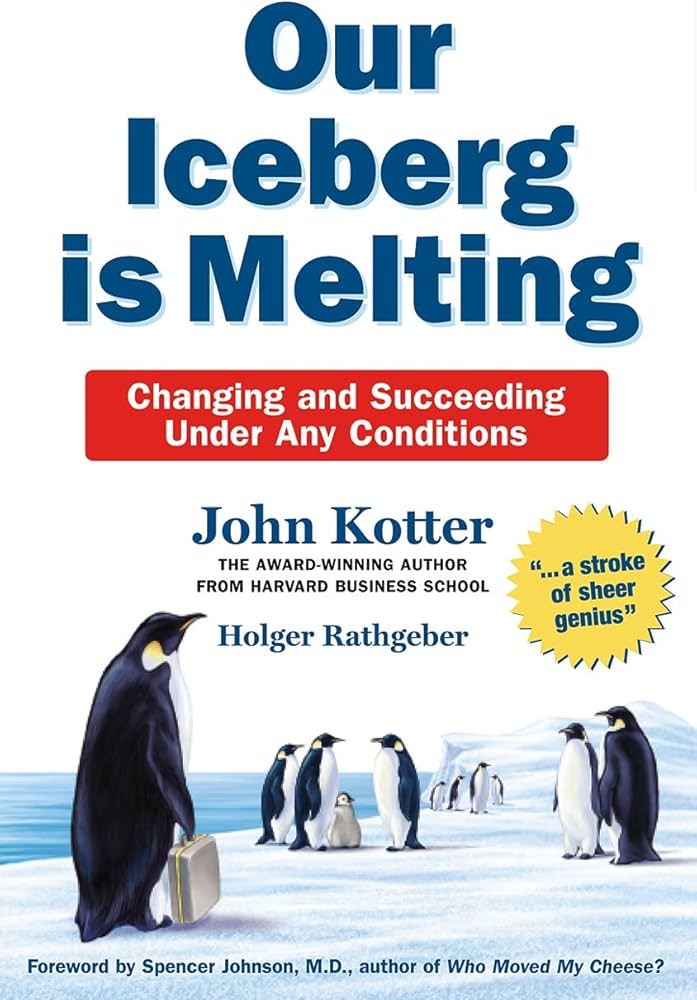
Eight steps to ensure a successful organisational change. Explained through a simple fable that is easy to read and understand. A group of penguins, in adverse conditions, use the steps, seemingly without knowing it.
As you read the fable, you may want to ask yourself, “What is my ‘iceberg,’ and how can I use what I discover in the story?”
All too often people and organisations don’t see the need for change. They don’t correctly identify what to do, or successfully make it happen, or make it stick. Businesses don’t. School systems don’t. Nations don’t.
Why use fables? Fables can be powerful because they take serious, confusing, and threatening subjects and make them clear and approachable. Fables can be memorable, unlike so much of the information that bombards us today and is forgotten tomorrow. They can stimulate thought, teach important lessons, and motivate anyone — young or old — to use those lessons. In our modern, high-tech world, we can easily forget this simple yet profound truth.
THE EIGHT STEP CHANGE METHOD
Set the Stage
1. Create a sense of urgency. Help others see the need for change and the importance of acting immediately.
2. Pull together the guiding team. Make sure there is a powerful group guiding the change — one with leadership skills, credibility, communications ability, authority, analytical skills, and a sense of urgency.
Decide What to Do
3. Develop the change vision and strategy. Clarify how the future will be different from the past, and how you will make that future a reality.
Make it Happen
4. Communicate for understanding and buy in. Make sure as many others as possible understand and accept the vision and the strategy.
5. Empower others to act. Remove as many barriers as possible so that those who want to make the vision a reality can do so.
6. Produce short term wins. Create some visible, unambiguous successes as soon as possible.
7. Don’t let up. Press harder and faster after the first successes. Be relentless with initiating change after change until the vision is a reality.
Make it Stick
8. Create a new culture. Hold on to the new ways of behaving, and make sure they succeed, until they become strong enough to replace old traditions.
The Role of Thinking and Feeling
Thinking differently can help change behaviour and lead to better results.
- Collect data, analyse it
- Present the information logically to change people’s thinking
- Changed thinking, in turn, can change behaviour
Feeling differently can change behavior MORE and lead to even better results.
- Create surprising, compelling, and, if possible, visual experiences
- The experiences change how people feel about a situation
- A change in feelings can lead to a significant change in behavior.
In a group, if all read this fable book, the Penguin language (icebergs, Alice, hero medals) can both facilitate communication and make discussions of difficult topics less confusing and threatening.
Snippets from the Story
Here are some important characters and events from the story.
Fred — Unusually curious and observant. Fred fished less and studied the iceberg (the colony they live in) more. Socialized less than average. He frequently went off by himself to take notes on what he had observed. He, however, is not an odd bird. Fred was just doing what seemed right to him.
Fred discovers the iceberg is melting and might break apart soon! The information Fred collected was beginning to cry out!
Alice and Leadership Council: Alice is one of the ten bosses. A tough, practical bird with a reputation for getting things done.
Fred goes to see Alice. Alice being Alice, he did not have to schedule an appointment. After inspecting the places Fred took her to, Alice began to see why Fred was so deeply concerned. The magnitude of the problem could be …?
Alice to Fred: I will need your assistance. I need you to be prepared to help others see and feel the problem. And be prepared that some birds won’t want to see any problem.
Louis — the Head Penguin. Alice had to be insistent and also flatter Louis to make him invite Fred for next Leadership Council meeting.
Fred Preparing for the Meeting. Fred considered writing a speech with lot of statistics. But after conversing with a few older birds, he learned that two of birds in the Leadership Council loved to debate validity of any statistics for hours and hours. Another usually falls asleep during long presentations. Another bird was very uncomfortable with numbers. He tries to hide his feeling, usually by nodding his head a great deal. At least two other Council members make it pretty clear that they did not like to be TOLD much of anything. They saw it as their job to be doing the TELLING. After much thought, Fred chose an approach that was different. Fred constructed a model of their iceberg. Constantly Fred used the model to orient his audience and illustrate his points. When Fred removed the top half of the structure to show the big cave and explain its disastrous impact, you could have heard a snowflake falling on the ground.
NoNo — One of the Leadership Council Members. A theory around his name was that his first words as a baby penguin were not “Ma” or “Pa” but “No, No.” Each sentence from NoNo after Fred’s speech came out louder than the last! Everything is fine! How do we know what he says is not just — a theory! Wild speculation! Fear-mongering! And the punch line — Can he guarantee that his data and conclusions are 100 percent accurate?
Fred — I cannot be 100% sure. But if it happens, it will be in Winter and there’s no time to act then!
Alice — Imagine parents who lost their children. Imagine they come to us and ask what were you doing? Why didn’t you foresee this crisis?
Louis, Head Penguin — We need to form a committee to analyze the situation and look into possible solutions.
Alice — But this is far, far from a normal problem. We must immediately call a general assembly and convince as many as possible that there is a big problem. We must get enough on our side that we have a chance of finding a solution that many will accept.
Fred — Uses a Glass Bottle filled with water to show how frozen ice can break the glass! If it does break next day, Council should call for assembly immediately! And they agreed.
General Assembly — Called for. Alice and Louis explains the situation with some questions handled by Fred. The complacent sense among all began to drain into the vast ocean. But Louis, Alice and Fred — by reducing complacency and increasing urgency they had taken exactly the right step in potentially saving the colony.
Louis forms a Team of 5.
Himself. Enough experience. Wise. Patient. A bit conservative. Not easily flustered. Respected by almost all except NoNo and the teenagers. Smart but not an intellectual heavyweight.
Alice. Practical. Aggressive. Makes things happen. Doesn’t care about status and treats everyone the same. Impossible to intimidate, so don’t even try. Smart but not an intellectual heavyweight.
Buddy. Boyishly handsome. Not the slightest bit ambitious. Well trusted and liked. Definitely not an intellectual heavyweight.
Fred. Youngster. Amazingly curious and creative. Level-headed.
Jordan. Logical. Well read. Fascinated by interesting questions. Not the most social of birds.
Pulling together the Team. After a satisfying meal, Louis led a discussion that rarely touched on the melting iceberg or what the five of them needed to do next. Instead he focused on life, loved ones, and their hopes and dreams. And they talked for hours. He would have liked a month to turn the birds into a close-knit team. But he did not have a month. So he did the best he could to take the essential step of pulling together a team to guide the needed change.
Team finding a solution. And they finally do. They speak to a Scout Seagull and agree that being a nomad is a good solution. The Team has succeeded in creating a vision for a new future!
Getting the message out. Following day, Louis called a meeting of entire colony. Louis reminds the birds of respect, discipline and responsibility and that these are not linked to a piece of ice! Then, he lets Buddy speak. Buddy tells the story of the Seagull. He was a very good storyteller! Louis concludes — This iceberg is not who we are. This is where we now live. We will PREVAIL! (Gone into history as WE ARE NOT AN ICEBERG speech!)
Alice. Followed up the meeting over subsequent days with slogans on ice posters. Remind them ALL THE TIME. More communication — everyday, everywhere. Communicating the NEW VISION was for most part successful.
Good News. Bad News. Obstacles. NoNo everywhere. Louis handles them well.
Children involved. Making everyone, even the children, feel empowered was unprecedented in the colony.
Short Term Wins. Scouts return. Amazing tales about the sea, about new icebergs they had seen. Celebrations. Hero Medals.
Second wave of scouts. More birds enroll this time! And a suitable iceberg for winter is found!
Colony moves. Not becoming complacent, next Winter, they move again.
The most remarkable change. Tradition dies a hard death. Culture changes with difficulty. Alice convinced Louis to shake up the leadership council. A tough selection process was created for scouts. Penguin school system added “Scouting” as a new required subject in the curriculum. Fred was asked to serve in Leadership Council as Head of Scouts. Buddy was offered important jobs but he turned them down but helped Leadership Council find other good candidates. His lack of ambition came to be seen as great humility.
Changing and Succeeding
Fables can be fun, but their power, as with the penguin story, lies in helping you act smarter: producing more, achievement, less confusion, lower stress, and a general sense of being in control through understanding what is going on around you.
First, read and reflect on the story. You might find it useful to read it more than once. You would be surprised how much is packed into this short tale.
Ask yourself questions that are suggested directly by the story: Am I living on a melting iceberg or an iceberg that could melt? Melting icebergs come in dozens of forms: product lines that are ageing, schools that are becoming irrelevant, services that are decreasing in quality, a business strategy that makes increasingly little sense, a new strategy whose implementation is sinking into the ocean. Who are the NoNos around me? Who are the Alices and Freds? Who am I?
Recap
- Create a sense of urgency to deal with a difficult problem
- Put a carefully selected group in charge of guiding the change
- Find a sensible vision of a better future
- Communicate that vision so others would understand and accept it
- Remove as many obstacles to action as was practical
- Create some sort of success quickly
- Never let up until the new way of life was firmly established, and
- Finally, ensured that the changes would not be overcome by stubborn, hard-to-die traditions
 altLearners
You must be logged in to post a comment.