Our richest art and science come from collaboration, not from brilliant loners; We need one another not only for love, but also for thinking and imagining and growing and being.
If you aspire to be creative, the most important step might be finding a trusted partner; who can support your strengths and offset your weaknesses.
A must read book for anyone managing/sponsoring what can be loosely called a creative or innovative work/project. Below are some of my notes.
Making a case
- The smallest indivisible human unit is two people, not one; one is a fraction. From such nets of souls – societies, the social world, human life springs. And also plays. 1+1 = Infinity
- For centuries, the myth of the lone genius has towered over us like a colossus. Or it’s alternative — creativity in networks.
- Fortunately, there is a way to understand the social nature of creativity that is both true and useful. It’s the story of creative pair.
- Steve Jobs and Wozniak; Marie and Pierre Curie; Van Gogh and his brother
- A rule than an exception: one member of the duo takes the lone genius spotlight while the other remains in history’s shadows
- Why have so many of their relationships been obscured and neglected?
- Hidden nature of partnership extends beyond particular pairs to whole categories of relationships. Golfers and caddies. Actors and Directors.
- Lone genius culture has robbed many women of the recognition they are due?
- Another reason interdependence so frequently remains hidden is that even when viewed directly, it can be hard to understand, and not just for outsiders but for the principals themselves.
- The pair is the primary creative unit. Groups create a sense of community, purpose, and audience but truly important work ended up happening in pairs.
- Are we setup to interact with a single person more openly and deeply than with any group? Our psyche takes shape through one-on-one exchanges?
- Three legs make a table stand in place. Two legs are made for walking, or running or jumping or falling.
- Pairs naturally arouse engagement, even intensity.
- What is this thing we call chemistry? What does that teach about the creative process?
SIX STAGES
Pairs follow a six stage progression.
- Meeting. Conditions and characteristics that engender chemistry or electricity — unusual similarities coinciding with unusual differences — become clear.
- Confluence. Over time, two individuals move beyond mere interest and excitement in each other — they truly become a pair by surrounding elements of their singular selves to form what psychologists call a “joint identity.”
- Dialectics. In the heart of their creative work, pairs thrive on distinct and enmeshed roles, taking up positions in archetypal combinations that point to the essential place of dichotomy in the creative process.
- Distance. To thrive for the long term, pairs need more than closeness. They must also find an optimal distance from each other, carving out sufficient space in which to cultivate distinct ideas and experiences in order to give a partnership an ongoing frisson.
- The Infinite Game. At the height of their work, pairs operate at the nexus of competition and cooperation, a dialectic that reveals the stark nature of power and the potential for conflict.
- Interruption. Driven apart by the same energies that pushed them forward. They lose, not their spark, but their balance, often due to some critical change to the context around them.
STAGE 1: MEETING
- Sometimes you meet someone who could change your life
- Just as loneliness can be a downward spiral, so can connection whorl us up into higher spheres
- A recognition — like you have found your lost brother or sister
- A major way people meet vital partners — is by going to a “magnet place,” or a locus for people with shared interests or yearnings. Schools are obvious magnet places. Magnet place can even be an event that lasts a few hours.
- When two people talk to each other, our own thoughts can’t possibly track the complexity of the dance!
- We need similarities, to give us ballast, and differences to make us move
- Bisociation — the sudden interlocking of two previously unrelated skills, or matrices, of thought. This is the stuff of creative breakthroughs
- They work together as smoothly, and as separately, as two hands on the same body
- Long term relationships are always beset by a paradox that human beings want both security and novelty. They want ease and familiarity and they also want to be challenged and aroused. They have to negotiate the need for both.
STAGE 2: CONFLUENCE
- There can be a major gap in time between the excitement of first contact and the entwinement of mature work
- Over time, develop a “couple identity” — more “we” and less “I”
- Cede independence for interdependence
- How to describe this progression? Gestation — slow and methodical growth? Or explosion — to the point of bursting? Or confluence — when two bodies of water flow into each other? One commonality — they convey how what happens can’t be reversed. No wresting the two rivers apart again. New compounds are formed; maybe a new organism is born.
- The stages of confluence: Presence -> Confidence -> Trust
- Movement to true partnership is often slow and meandering
- Presence is the building block for authentic interaction
- Laughter may be the shortest distance between two brains
- For pairs to gel, it is essential that confidence deepen over time
- If confidence is specific, trust is holistic. If confidence is about what you expect to do with a person, trust is more about how you regard that person. An emotional state that dismisses doubts about others.
- How does trust arise?
- In the final step, trust elevates into faith.
- Out of this faith can come a place of true abandon and intense exchange.
- What are the core qualities of creative pairs who have achieved confluence?
- A good place to begin is with ritual, since this is often the foundation of creative practice.
- For individuals conducting rituals, the core purpose is to discipline the unruly mind, to make acts that are automatic and definite amid a creative process that involves so many utter unknowns
- Many pairs have what we could fairly call a private language
- Mark and Sheryl from Facebook: Mark used the term high-bandwidth to describe his exchanges with his COO — “we can talk for 30 seconds and have more meaning be exchanged than in a lot of meetings that I have for an hour.”
- What about wordless communication — commonly called telepathy?
- Creative pairs often say they don’t remember who did what
- On some level, thinking is social!
- Confluence has several critical variations
- Asymmetrical — One partner absorbs the other — Disciple and Guru
- Distinct — they maintain separate public identity — their rivers run together underground
- Overt — partners join together in rough equality to produce work with which both are publicly associated.
- Eroticism? Sharp distinctions cannot be drawn between physical and creative desires?
- When the work gets really good, pairs often find midwives to help birth the next phase of their union
STAGE 3: DIALECTICS
- To understand creative relationships, we need to grasp the character of two people together, how disparate qualities come into dynamic relation with one another
- Clearly etched but intricately entwined roles are the primary way to understand what pairs do and, indeed, who they are
- Drummers need Guitar players. Architects need contractors. But there is a distinction that runs beneath the surface. Three archetypes recur most often — the star and the director, the liquid and the container, the dreamer and the doer — and each speak to a significant Dialectic. Dialectic is a fancy word but it simply describes the process by which something singular emerges out of the interaction or duality.
- All traditions return to a concept of overlapping opposites — like yin/yang
The Star and the Director
- History often neglects the offstage partner
- Like Mahatma Gandhi with Mahadev Desai
- Like Vincent and his brother
The Liquid and the Container
- In its natural state, liquid tends to disperse. Liquid-type creatives are drawn to make lateral associations rather than linear progressions. They’re often exciting, excitable characters, boundless. They embody the promise and peril of risk and are simultaneously repelled by and drawn to people who impose constraints, who can offer them shape. Without those constraints, they will spill out onto the sidewalk, evaporate in the sun.
- The container sort exudes order and clarity. He is hollow inside, he needs filling up and can take on the character of whatever he becomes a vessel for, whatever he can help deliver.
The Dreamer and the Doer
- Edison, more a Dreamer, and his Team of Doers
- Dreamers generate ideas, start new projects, inspire others to join them. They may also start things they cant finish and break promises
- Doer-type creators are productive, efficient, and dependable. They excel at finishing, have a realistic sense of what’s possible, and can set priorities and make decisions. Yet doers may struggle to be original, to initiate, to see the long view, and to identify a sense of purpose.
- With creative teams, we often see the union of vision and execution!
- Creativity is what happens when the dreamer meets the doer!
A Few MORE Insights
- For human beings, social influence is the water we swim in — and we often pretend it’s not there. In social science, assuming that an individual’s behavior is due to internal factors rather than external ones is called the fundamental attribution error. When it comes to appreciating creativity, this error can be toxic, because it leads us to ignore how profoundly people depend on each others, not just for help in discrete situations but to shape their very identities.
- We need reasonable predictability in our relations, But we also need, if not the constant presence of surprise, at least the potential for it.
- Role rigidity can be maddening. Many of us struggle when we visit our families over the holidays. I am 42 but still the baby when I am around my two older brothers! Similarly, rigid patterns are a common feature in workplace stagnation. The solution? Can one person go to the other person’s place? The degree to which a person can go to another person’s place is a measure of vitality and range of a relationship — and its creative potential too.
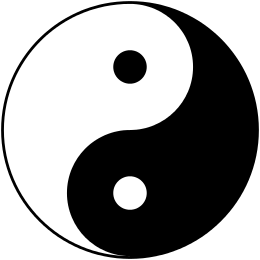
- Dyadic dichotomies, are one of the basic ways we learn about the world. Mind versus body. Nature versus Nurture. The same is true with creative dialectics. The best way to approach a pair at the start is to look for clear divisions and role clarity. But the way to really deepen knowledge of pairs is to look at role fluidity.
- Taijitu — an approach to yin and yang begins with identifying two basic qualities, the black and the white, nestled against each other, each in its own space. Yet the black and white fields do more than swirl around each other; they contain aspects of each other. Within the white portion likes a black spot, and within the black portion a white dot. The same is true of creative partners.
- The myth that artists need only withdraw into themselves to create has its counterpart in a psychological tradition that pits individuals against the world around them.
- Daniel Goleman’s work on Social Intelligence shows that how we think and feel is a function of how we relate to others.
- “Collaboration is good” vs “Creators need time alone” argument is as helpful as an argument about breathing where one side insists that we absolutely must inhale, while the other insists on exhaling. Conditions requires for human beings to thrive in one another’s company are also a function of balance.
- Dalai Lama – brilliant at being alone and at connecting.
STAGE 4: DISTANCE
- Quote: We know about friendliness that it does not abolish the distance between human beings but brings that distance to life
- Quote: “No” is the wildest thing we consign to Language?
- Most common question about relationships is “Are you close?” Better question is about how two people best animate the space between them — how they maintain the élan of curiosity and surprise alongside familiarity and faith.
- Independence seeds interdependence — and vice versa
- Many creative people who appear deeply isolated might actually be taking what seems, to ordinary folks, an unusual amount of space to recharge
- For such people, introversion may be a misleading description. It suggests an orientation away from others
- While introverts often need to minimize stimulation, extroverts often need to maximize it. Performance increases with physiological or mental arousal — but only up to a point, after which stimulation has a negative effect. All of us need some version of the balance.
- Highly functional couples commonly say that one key to a good relationship is giving each other plenty of space. But a big reason why there are so many dysfunctional relationships is that it’s hard for a lot of us to know what that really means or what it would look like in our lives.
- There’s no formula. Optimal distance depends on the temperament and pursuits of each member of the couple, and how they play together. A writer works for years before bringing the manuscript to an editor, then talks to her everyday while the book moves towards production. Cofounders of a startup spend sixteen hours a day together doing grunt work, then one recedes to a board role while the other stays at the reins as CEO
- Another complicating factor is that distance can take so many forms. It may be geographic. It may be temporal (passage of time between contact is an hour or a year).
- A key element of creativity is to separate idea generation from evaluation and elaboration. For many creative people, the generation phase is best done in solitude. Presence of other people draws you toward that testing state of mind. A nodding head or a furrowed brow. Or your partner takes up the idea like a baton in a relay race. Perhaps she puts it away like a broken toy. Even if she does not react, you cannot help but devote some mental energy to imagining what she’s thinking
- With ample distance, pairs can move between these two modes of being and thinking. The same rhythms come to affect work sessions, where two partners may move between generating and testing ideas, between focusing on a task and goofing off, between rumination and association.
- Rather than a set position, optimal distance is more like a dance.
- Eroticism is not the fulfilment of yearning (sex) but the heightening of that yearning.
STAGE 5: THE INFINITE GAME
- A tension manifests in all great creative pairs
- Potential of negation combined with affirmation, opposition with coordination, competition with cooperation. These set of qualities charge creative work like the positive and negative poles of a battery. What keeps the current flowing? And what causes a short circuit?
- Sports nicely illustrate the fundamentals of competition — they are built of what are called “finite games” — clear contests, bounded in time, with rules designed to produce a winner and a loser. Weight-lifters bench press an average of 2 kgs more when competition. Competition is also linked to increased heart rate and blood pressure even when the challenge requires little physical exertion (racing toy cars).
- Foils who seek to stymie each other can also bring out each other’s best qualities. Foil is the perfect word here. As a verb — to prevent something undesirable, to impede, or scuttle. As a noun — a thing that by contrast emphasizes the qualities of another.
- Competition is when you need to kick the guy’s ass to get what you want. Rivalry is when you want to kick the guy’s ass.
- Three benefits rivals offer. First, they push us harder — motivation. Second, they model what we need to do — inspiration. Third, they keep us in the game — dedication.
- Just as traditional collaborators need time to achieve confluence, rivals tend to grow entwined over time.
- As students must master algebra to take on calculus, we must grasp competition to look beyond it. Most creative work does not post to a scoreboard. Encounters than end with a winner and a loser are rarely the most interesting.
- The critical distinction is between the finite and the infinite game. A finite game is played for the purpose of winning. An infinite game for the purpose of continuing the play.
- Where finite games follow predetermined rules, intended to eliminate players until one stands on top alone, infinite games are constantly adjusted so that both players can remain standing.
- Finite games are like formal debates, where artificial constraints impose order. Infinite games are like the grammar of a living language, where organic growth magnifies complexity. Where finite games hinge on competition, infinite games operate at the intersection of competition and cooperation.
- Co-opetition!
- Co-existence of cooperation and competition is more than institutional. It’s basic to human relations and the human psyche. Most members of pairs are in coopetition most of the time — though they may not know it.
- Comparison is a species of competition!
- Optimal point between cooperation and competition? Magic mix is to have both. Power (command over resources), authority or status (the respect that leads to affection, loyalty and solidarity) — most effective leaders have both. A strong CEO will have the power to hire and fire and the authority to inspire and direct.
- It is possible to be too competitive. Lance Armstrong took drugs to ride better and break away from the pack but by breaking the compact that made him legitimate — lost everything.
- It’s also possible to be too cooperative. Excessive generosity is regarded as poorly as excessive selfishness.
- Optimal tension between competition and cooperation is not the same as balance. Balance equals motionlessness, equilibrium, steadiness; that is, lack of change. Any system that focuses on order at the exclusion of disorder soon becomes a rigid, homogenous equilibrium system where no change is likely or even possible.
- For creative advancement, change is essential. And while all creative exchange will have a cooperative element, competition on the whole takes a slight edge. This may seem counterintuitive, since we generally yearn for order, unity, and connection. But progress depends on disorder and fluidity. Sometimes the best aids to our work are people who knock us most off balance.
On Power Clarity and Power Fluidity
- To properly view the dynamics of creative pairs, we must look at more than simple opposition and cooperation. We must look at differentials in power.
- Power is a real and pervasive force in all relationships. It may be as apparent as medals on a uniform or as subtle as a downward glance. Also multi-faceted and multi-layered.
- But when you get down to it, one person is usually running the show. Or one person needs the other more. Or one person would find it easier to leave.
- What is the psychology of power?
- Even 5 year old’s quickly establish social ranks.
- Less powerful partner makes the greater internal adjustments in their emotional convergence.
- Power is to relationships what gravity is to matter.
- In creative pairs, the power disparity may be clear and recognized (Steve Jobs and Jony Ive?).
- The chief advantage of power clarity is absence of strife
- Yet every advantage of power can become a disadvantage. What reflects confidence also reflects inattention to the perspective of others.
- Powerful people tend to talk more, interrupt others more, flirt more, and engage in conflict more readily. Left unchecked, they lose their inhibitions entirely.
- Power itself does not corrupt, but pure power inevitably does. The skills most important to obtaining power and leading effectively are the very skills that deteriorate once we have power.
- When used appropriately, their courage, confidence, tireless energy, and fighting spirit make them natural leaders in competitive situations.
- Confidence can become arrogance, toughness becomes belligerence, and their competitiveness becomes a fight to the death in which even teammates are seen as rivals that have to be vanquished.
- To be a strong pair, both members must be able to lead and follow. One way to glimpse its essence is to consider the dance of tango. This dance is the most strictly lead/follow. Like driving a car. Only one can take the wheel. The follower teaches the leader how to lead.
On Conflict
- Power clarity can negate conflict but stifle creativity. Along with sufficient clarity, pairs need some fluidity. Thus conflict is an organic part of the process. That’s the bad news.
- The good news is that conflict is not necessarily bad.
- Rather than indicating a problem that needs solving, conflict may emerge out of right behavior — people acting their parts, expressing their opinions, bringing their perspectives to bear. Being the one who daydreams and comes late, or being the one who can’t stand it when the other guy is late.
- Conflict, by its nature, heats us up emotionally.
- Also, high indices of conflict are positively associated with an experience of intimacy. Think about the people you can really argue with. They’re often your dearest friends.
- Conflict can also be a form of social play
- To the untrained eye, any dog fights can be scary to watch
- Conflict can highlight differences in perspective; it might be the quickest way to discover a problem that need solving.
- The pair’s potential arises in the first place from foundational differences in temperaments or styles or backgrounds or modes of thinking. It should take work to relate. With rigid power, the burden of repair falls entirely on one party, but true creative pairs will always, to some degree, have to reach each other.
- Anyway, the last thing a pair wants is total stability
STAGE 6: INTERRUPTION
- Either someone dies, or the project ends, or troubles become more than the partnership can bear. These troubles usually grow organically out of the qualities that led the two people to each other in the first place. Outside forces play a role too
- Analogy — divorced couple with kids! No pair ever ends!
- But for creative partners post-divorce, life can be even weirder than for ex-spouses. An individual’s very self has taken shape through work shared with another person. So what exists of that self now?
- These questions go far beyond the legal or emotional.
- Stumble — same energies that push a pair forward can also knock them
- Opposites do attract — so they enter the relationship celebrating the differences. At some point, it’s inevitable that the differences pose challenges that people don’t know how to deal with
- A partner with a great sense of humor can be later — “plays too many jokes”
- They don’t want to go away from the person necessarily, they want away from the feeling.
- The people we’re drawn to may unsettle us. They probably should unsettle us.
- Wedges — most salient wedge for successful people is success itself.
- It was between Jobs and Wozniak
- Money brings about a self sufficient orientation in which people prefer to be free of dependencies and dependents. High socioeconomic status can make people more selfish and insular (as well as less ethical and compassionate).
- Success can also bring to the surface quarrels about credit
- The most common wedge comes in the form of a third person who gets between the pair
- The opposite of love is not hate — it is indifference. Explains how pairs can remain as performers or business partners
- Some pairs stop burning down the house and settle into profitable routines
- To make work with another person is to open a kind of joint bank account in which two individuals deposit energy, time, creative daring — but where rights of withdrawal are beyond either individual’s control
 altLearners
You must be logged in to post a comment.