Most people, deep down, are pretty decent.
In “Humankind: A Hopeful History,” the author thinks this is a radical idea. You have to read this wonderful book to start comprehending why is this so!
There’s a great deal of reassuring human decency to be taken from this bold and thought-provoking book. Below are some notes I took to keep coming back to.
Veneer Theory
Humans are selfish, aggressive, and quick to panic. Civilisation is nothing more than a thin veneer that will crack at the slightest provocation!
THIS IS A MYTH! It’s when the bombs drop or flood waters rise, that we humans become our best selves! Contract to what the movie Titanic protrays, according to a eye witness, there were no crier of fear, no running to and fro. On Sep 11, 2001, at Twin Towers, that is the case too. It was “No, no, you first!” everywhere!
Hurricane Katrina
Newspapers filled with accounts of rapes, looting, snipers over New Orleans. Chief of Police – City slipping to anarchy. Governor – Disasters like this bring the worst in people. Even Gaurdian UK has this to write – “Remove organized, civilized life – food, shelter, water, security – we go back to Hobbesian nature – revert to being apes!”.
Months later, what was revealed is different. Police chief could not concede to a single reported rape or murder. Looting, yes, to survive – bandied with Police in some cases. 100s of civilians actually formed rescue squads. The city was inundated with courage and charity!
Catastrophes bring out the best in people. Picture we are fed by media is opposite! But what was the cost in New Orleans? Emergency workers – slow to respond. National Gaurd – killed innocent civilians! Authorities end up unleashing a second disaster.
ELITE PANIC comes from powerful people who see all humanity in their own image. Dictators, Governors, Generals – they all too often resort to brute force, to prevent scenarios that exist only in their heads, on the assumption that average Joe, is ruled by self-interest, just like them!
Nocebo Effect
Take a fake pill thinking it will make you sick, chances are it will.
A drug we take everyday. A drug that causes
- Mis-perception of risk
- Anxiety
- Low mood levels
- Learned helplessness
- Contempt and hostility towards others
- De-sensitization
It’s NEWS! News is about the exceptional. The more exceptional, more newsworthy! Terrorist attack. Violent uprising. Natural disaster.
We are trained to see selfishness everywhere.
- Religions -> Humans are mired in sin
- Capitalists -> We’re all motivated by self-interest
- Environmentalists -> We’re all destructive
Two Wolf’s Fighting Inside
One is evil – angry, greedy, jealous, arrogant, cowardly. Other is good – peaceful, loving, modest, generous, honest, trust-worthy. Which one will you feed? In a crisis, which turn you will take?
In a survey done in most nations, people think things are getting worse. But extreme poverty, victims of war, child mortality, crime, famine, child labour, plane crashes – all came down!
NEWS ≠ REALITY
Why are we susceptible to this doom and gloom?
Negativity Bias: We are more attuned to bad than good. Hunting gathering days – too much fear is ok. You Live! Availability Bias: What we can easily recall, we assume is relatively common.
We are not rational enough to be exposed to the press – Taleb
Digital Age -> only more extreme. Old days, journalists wrote for the masses. Now, Facebook, Twitter, Google know what shocks you. What makes you click! To sell ads, you need more sensational click-bait! News has become to mind, what sugar is to body!
Even History, Psychology, Science books are about the exceptional. War. Catastrophy. Tyranny. Selfish Gene, for example. Even Economics is much the same. All model legislations are built on the premise that we are always intent on personal gain. Even all great Western Philosophers have their own version of Veneer theory.
Our grim view of humanity is due for a radical revision!
To stand up for human goodness is like chopping head of a monster that grows 2 back. Veneer theory is a zombie that keeps coming back.
To stand up for human goodness is to take a stand against the powers that be. For the powerful, a hopeful view of human nature is down-right threatening. Subversive. Seditious. It implies that we are not selfish beasts that need to be reigned in, restrained, and regulated. It implies that we need a different kind of leadership. In a company with intrinsically motivated employees, there is no need for managers! In a democracy with engaged citizens, there is no need for career politicians!
To stand up for human goodness means weathering a storm of ridicule. You will be called naive. Obtuse. It is easy to be a cynic. Still, it’s time for a new view of human kind.
Lord of Flies
A popular book that even won the author a Nobel. But it portrays dark depths of mankind. But what would real children do if they found themselves on an island? Author shares such a real story that actually happened on Island of Ata.
Cynical stories have a marked effect on how we look at the world! It takes much manipulation to bring out the worst in people. If “Lord of Flies” is required reading for teens, isn’t it a Nocebo Effect? Why not tell stories on friendship – how much stronger we are if we can lean on each other!
Hobbes vs Rousseau
A philosophical boxing ring!
| Hobbes | Rousseau |
| Pessimistic | Optimistic |
| Wants us to believe in wickedness of human nature | In our heart of hearts, we are all good |
| Civil society alone could save us from human instinct | ‘Civilisation’ is what ruins us! |
| Human beings are driven by fear. Fear of the other. Fear of death. We long for safety. Have a perpetual and restless desire for power after power. This philosophy is used by Governors and Generals. Give us power or all is lost! | Man is naturally good. It is from these institutions alone, that men become wicked. The first man who enclosed a piece of land and said “this is mine” founded private property. How many crimes, how many wars, murders, horrors followed! |
Rousseau argues ever since birth of civil society, things have gone wrong. Farming, urbanisation, statehood – they hadn’t lifted us out of chaos, but enslaved and doomed us. Invention of writing and printing press only made matters worse.
Before bureaucrats and kinds, humans probably existed in a state of nature as compassionate beings. Now we have become cynical & self-interested. Civilisation is a giant mistake we never should have squandered our freedom for!
Whole science of economics became premised on hobbenesian notion of human nature, which sees us as rational, self-serving individuals. Children too no longer grow up free and unfettered.
Whenever an idealist advocates more freedom & equality, Rousseau beams down approvingly. Whenever the realist/cynic grumbles that this only sparks more violence, Hobbes nods in agreement.
WHICH PHILOSOPHER WAS RIGHT?
Homo Puppy
Genetically, we are 60% identical to bananas, 80% to cows, and 99% to chimpanzees. But we ended up milking cows and caging chimpanzees. And set foot on moon. Why should that 1% make all the difference? Why us?
Judged on raw brain power, humans do no better than our hairier cousins. So, then, what are we using our great big brains for? Are we more cunning? No – we’re predisposed to trust others – which explains how con artists can fool their marks. Also, we are bad liars. We are the only animal that blushes!
It’s around here in the book, the author takes us on a journey into work Dmitri Belyaev and Lyudmila Trut in Russia. Do read the book to catch up with it. My notes might be too brief on this subject.
The question they worked on is this – how do you turn a fierce predator into a friendly pet? Why do domesticated animals have cute features including small brains and teeth and floppy ears, curly tails, or white-spotted fur? The researches suspected these features were a by-product of something else, a metamorphosis that happens organically over long periods of time consistently selected for one specific quality – Friendliness. The researches went on to replicate within a couple of decades turning wild animals (silver fox, never domesticated before) into pets – simply by breeding only the most amiable individuals. They noticed many physical changes too. Foxes’ ears dropped. Tails curled. Spots appeared. Snouts got shorter. Males increasingly resembled females. None of these were traits researchers selected. Their only criterion had been friendliness – all other characteristics were just by-products. The more amiable foxes produced fewer stress hormones and more serotonin (the happy hormone) and oxytocin (the love hormone).
Extending to humans, Dmitri’s theory was that people are domesticated apes. That for tens of thousands of years, the nicest humans had the most kids. That the evolution of our species, was predicated on ‘survival of the friendliest.’
Our own bodies should hold clues to prove this theory.
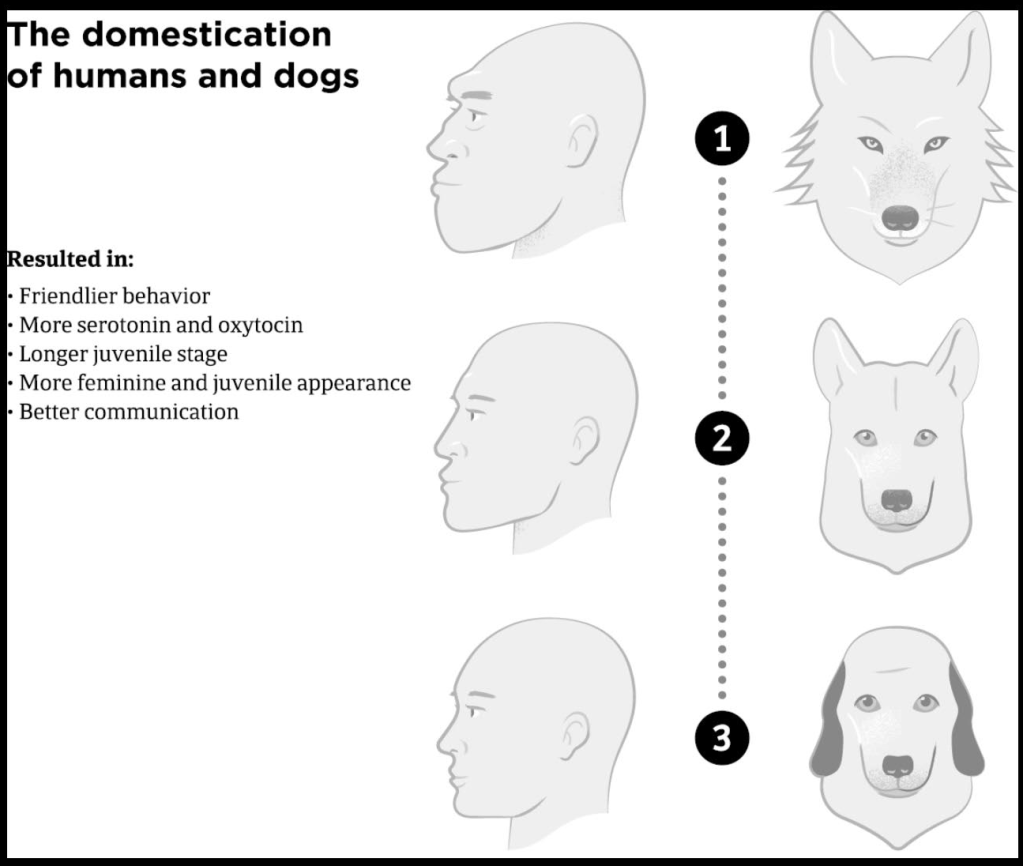
But how come Home Puppy was able to conquer the world?
Was intelligence a coincidental by-product of friendliness? Dmitri’s research too proved that latest generation of friendly foxes was not only remarkably astute, but also much smarter than their aggressive counterparts. Up until then the assumption had always been that domestication diminishes brainpower.
We can all count to 10. But can each of us come up with a numeric system? We also seem to be having a unique skill: social learning. That is, the ability to learn from others. Human beings, it turns out, are ultrasocial learning machines. We’re born to learn, to bond and to play. Maybe it’s not so strange, then, that blushing is the only human expression that’s uniquely human. Blushing, after all, is quintessentially social – it’s people showing they care what others think, which fosters trust and enables cooperation.
Humans have another weird feature – we have white in our eyes. This unique trait lets us follow the direction of other people’s gazes. Every other primate (200+ species) produces melanin that tints their eyes. Like poker players wearing shades, this obscures the direction of their gaze. But not humans. We’re open books. Imagine how different human friendships and romance would be if we couldn’t look each other in the eye. How would be able to trust one another? Our unusual eyes are another product of human domestication. As we evolved to become more social, we also began revealing more about our inner thoughts and emotions. Our eyebrows too reveal surprise, sympathy or disgust!
Humans, in short, are anything but poker faced. We constantly leak emotions and are hardwired to relate to the people around us. But far from being a handicap, this is our true superpower, because sociable people aren’t only more fun to be around, in the end they’re smarter too. Development of human language, too, is a product of our sociability.
Rank & Yank System
Enron’s CEO Skilling set up a rank & yank system for performance reviews. A score of 1 placed you among the company’s top performers and gave you a fat bonus.
 altLearners
You must be logged in to post a comment.