Content adapted from: https://www.commonsensemedia.org
This learning capsule has 12 topics. You may not be able to complete all topics in one session.
Consider completing this learning capsule in two sessions (30-60 min each).
- Media Balance is Important
- Pause and Think Online
- Let’s Give Credit!
- Is Seeing Believing?
- A Creator’s Rights and Responsibilities
- Reading News Online
- Finding Credible News
- This Just In!
- Hoaxes and Fakes
- Challenging Confirmation Bias
- Clicks for Cash
- Filter Bubble Trouble
Media Balance is Important
Sometimes what we’re doing online is so entertaining or fun that it’s easy to lose track of time. That’s why it’s important to stop and notice when people and other fun things are happening in real life around us. It’s important to follow certain rules to make sure we’re making healthy and responsible choices.
Can you keep your tech use in balance?
- It’s important to always pause what you’re doing on a device to acknowledge the people around you.
- If you’re playing a game or doing something on a device, make sure that you’re not ignoring anyone!
- Try to keep your devices in silent mode when you sleep
- A phone or tablet is someone’s personal property. You should ask permission before grabbing someone’s phone — including your parents’ phone. Remember that a lot of us use their phones for work and have important information saved in them. Treat their devices with respect!
Remember – keep your online and offline activities in balance.
Pause and Think Online
Who is a Digital Citizen? Someone who uses technology safely and responsibly.
The Digital Citizens pledged to travel safely on the internet.
How can we be safe, responsible, and respectful online?
- It’s important not to believe everything you see on the internet, since people can make things up that aren’t true. Always think carefully about the things you see online!
- It’s a good idea to take a break from technology every once in a while, so you can spend time being active and hanging out with friends and family. Set a time limit so that you don’t end up spending too much time online!
- Be careful with messages or emails or forwarded links from people you don’t know, since the information may not be appropriate or safe.
- We are kind and courteous to others, both in person and online.
- Never share your usernames and passwords. It is considered private information and something you want to keep safe. Others could log in to your account and pretend to be you.
Remember that when you’re online, you should pause and think to make sure you’re doing the right thing!
Let’s Give Credit!
A lot of times when you do school or college projects, you look online to find information about things you’re learning about. You might find images, articles, or videos that you want to use in your project. It’s totally fine to do that, but we just have to remember to give credit to the person who created what you use.
How can you give credit for other people’s work? With so much information at our fingertips, it is important to learn what it means to “give credit” when using content you find online.
To give credit for the information you find online and want to use in your work, you must include the following:
Author: A site might not always list an individual author, especially if many people helped to create the piece of work. In that case, you should list the name of the organization or group where the information came from.
Title (the video, article, picture): This can usually be found above the information.
Website: Write the website URL and stop after top-level domain, such as .com, .org, or .edu. You can also link directly to the page where you found the information.
Some examples:
Author: Jay Gomez
Title: Reduce, Reuse, Recycle
Website: http://www.recyclingforall.org
Author: Layla Conrad
Title: Olympic Sports!
Website: http://www.sports.olympicgames.com
Author: The National Birding Association
Title: Bald Eagles
Website: http://www.learningfunfacts.com
Note: You can also explore official citation styles such as MLA.
Is Seeing Believing?
Why do people alter digital photos and videos?
The web is full of photos, and even videos, that are digitally altered. And it’s often hard to tell the difference between what’s real and what’s fake.
Why someone might alter a photo or video in the first place?
Sometimes people alter photos just to be creative and to have fun. Like in these examples.
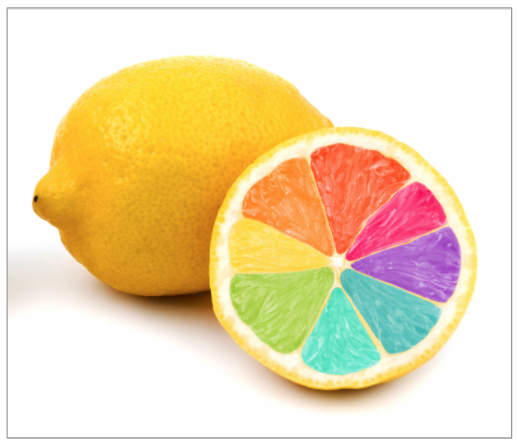

Other times, it’s to make people believe something. This is called persuading.
One way to figure out why an alteration was made is to see how obvious the alteration is. Sometimes, when it’s really obvious, the goal is to entertain or to be creative, like the tiger-parrot below. When it’s not so obvious, sometimes the intention is more to persuade, like the magazine cover. This isn’t always the case, but it can be a clue.
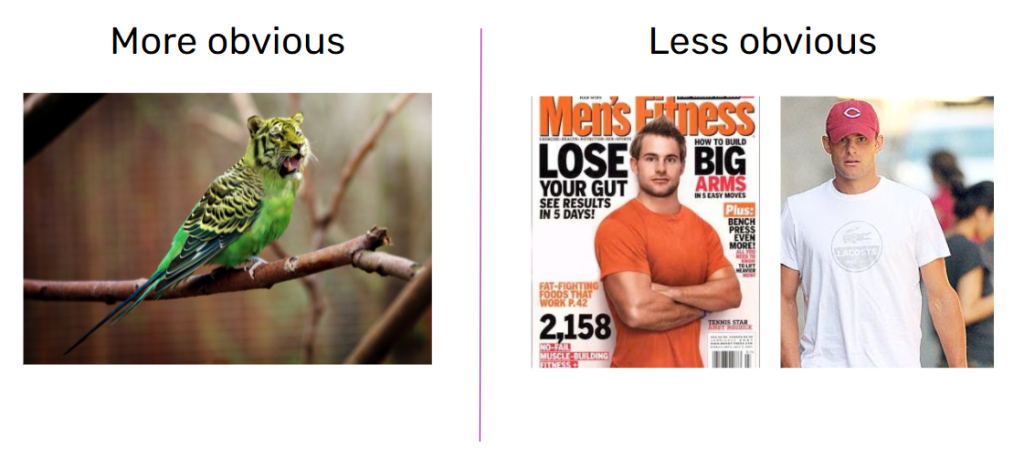
Photo Re-touching
Here is an example of photo retouching, which is when a photo is digitally altered to enhance the way someone or something looks.
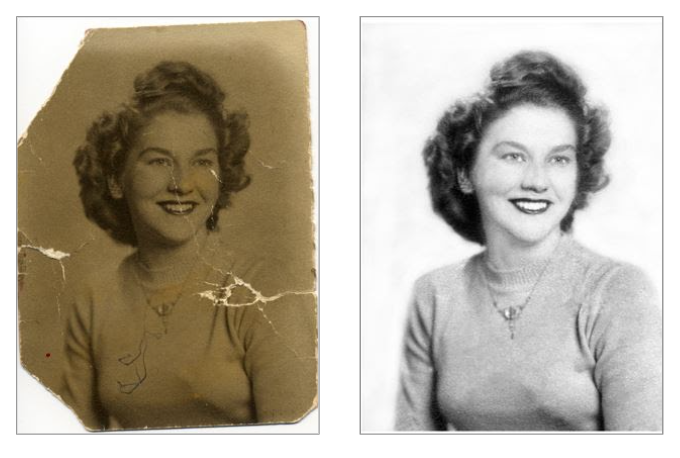
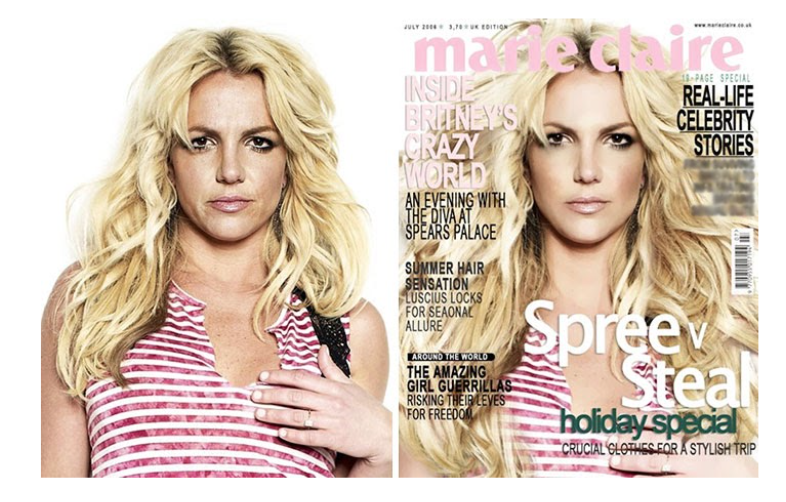
Photo retouching is often used in advertising, where photos of people are altered to make them look skinnier, have clearer skin, or look younger. Advertisements are messages or photos that are made to persuade someone to buy a certain product.
Even Videos are altered!
Here are couple of fun examples:
https://www.youtube.com/watch?v=DLcKDq5FpFk
https://www.youtube.com/watch?v=TttDafkNzWA
Closing Questions
- What do you think about altering photos?
- Is it OK to do?
- Does it depend on the type of alteration?
- How so?
A Creator’s Rights and Responsibilities
What rights and responsibilities do you have as a creator?
It’s common to use images you find online, for school projects or just for fun. But do you understand which images are OK to use and which ones aren’t?
A creator is simply someone who creates something, like a photo, a song, or even a dish of food.
We are all creators. Think about a time you created something, when you wrote down an idea, took a picture or video of something, made a piece of art, or uploaded something you made to the internet (to your Instagram or Facebook or other social media platform).
What about a time when you’ve used someone else’s creation online, like an image or a quote from an article?
When we create something, it’s automatically ours. We have protections in place to make sure others don’t use our work and say it’s theirs. This protection is called copyright. It does not matter if a work is hard copy or digital, it is still protected by copyright. A regular copyright means you must get permission from the creator to use the work.
Public Domain
The ability to use copyrighted work without permission; but only in certain ways and specific situations
Fair Use
Creative work that’s not copyrighted and free to use without permission
License
Creators can choose what kind of copyright license they want. They can determine how strict or open to be about others using, sharing, altering, or making money from their work. Creative Commons is a copyright license that allows for flexibility in how others use the work (such as to copy, alter, or make money from it).
Attribution
A citation is a formal version of attribution with very specific information about the work (MLA, APA, etc.).
Plagiarism
When you don’t provide attribution to the creator of the work, it’s like stealing.
Do you think copyright is important? Why does it matter who gets credit for something?
In addition to concrete benefits like money or fame, there is also fairness: If someone puts in the effort and time to create something, that person deserves to get the credit and have a say in how it gets used. As a digital citizen and creator, you have a right to decide how your creative work is copyrighted. But you also have a responsibility in how you use the work of others.
Ask and Attribute
Before you use a photo online, you should:
- “Ask” what kind of copyright license a photo has and whether you need permission to use it, and
- If the license allows you to use it, make sure to “Attribute” it to it’s creator.
To figure out what type of license an image has:
- Do a reverse image search to try to find the original creator of the image.
- If the photo has a regular copyright, email or get ahold of the creator to ask permission.
Note: Though students and educators have the right to use copyright-protected work for education purposes, it’s best to follow the tenets of “fair use.”
Do watch this video on what constitutes fair use.
Four Factors of Fair Use
- Purpose: You are inspired by Marvel’s comic superhero Black Panther. You draw your own original version of the character and use it to make a T-shirt. This is likely fair use. If you copy the original Black Panther image onto a T-shirt and try to sell the T-shirts, that is not fair use and would be a copyright infringement.
- Nature: If you are writing a research paper and want to use a quote from an article or book to support your ideas, this is fair use. You need to provide a citation for the author/work. Using informational works such as news, magazines, scholarly books, and articles is a better case for fair use because it encourages the spread of ideas and benefits the public.
- Amount: If you are creating a video for a school project, and a documentary by National Geographic supports your ideas, you can argue fair use by using a short clip from the movie. And because it’s for school, you have a more compelling argument for fair use.
- Effect: Copying a still image from a movie and making it into a meme as a parody or commentary is typically an argument for fair use. The meme would likely not have a negative effect on the sales or performance of the movie. (In this case, the meme uses a small amount of the original work, is used for noncommercial purposes, and is transforming the original work into something different.)
Closing Thoughts
- What is copyright infringement? What can it result in?
- How are works in the public domain different from copyrighted works?
- Why is determining fair use “tricky”?
Reading News Online
What are the important parts of an online news article?
When you want to get the latest news, where do you look?
Every part of an online news article has a name and a purpose. Reading news online can be tricky because there’s a lot of stuff that may look like news, but it’s not. So it’s important to learn the difference!
It’s important to know the difference between a news article and other parts of a news website that represent commercial interests (commercial – intended to make money). Advertisements and sponsored content are parts of a news website that are commercial.
Read this guide to spot the different sections in a news article.
Finding Credible News
How do you find credible information on the internet?
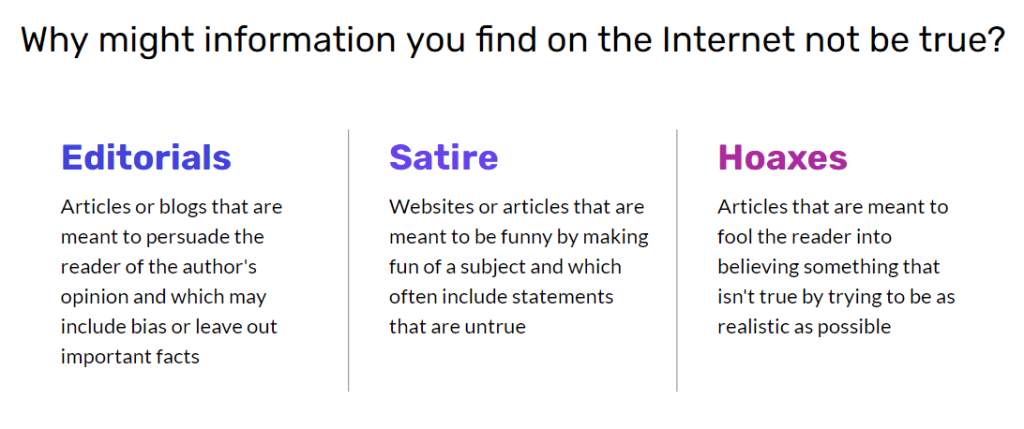
The web is full of questionable stuff, from rumors and inaccurate information to outright lies and so-called fake news. So how do you weed out the bad and find what’s credible? Why and how false information ends up online in the first place? How can you evaluate the credibility of what you’re finding online?
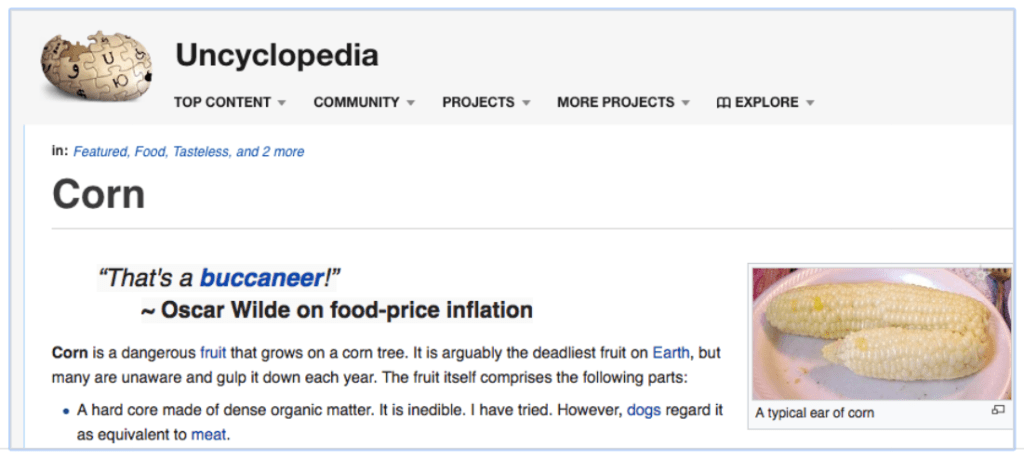
People put information that may not be fully true online all the time. Editorials, satire, or hoaxes.
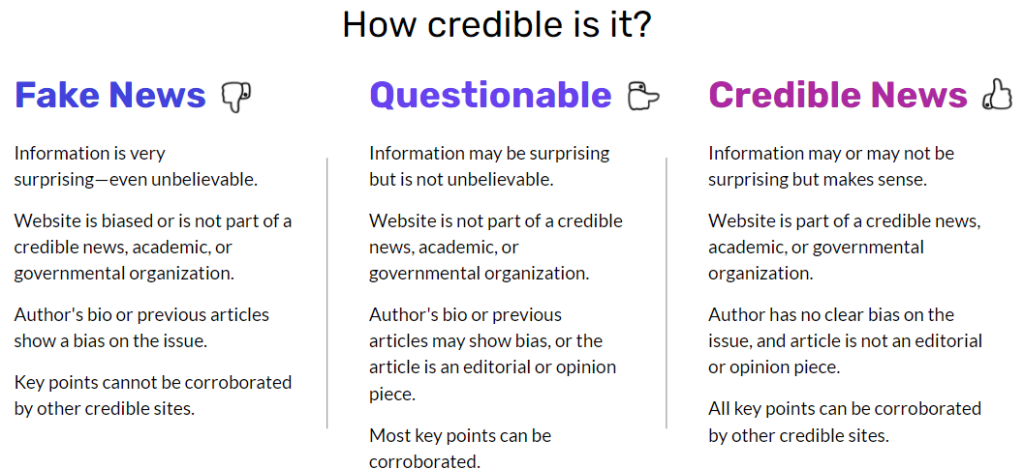
Fake news can be tricky — sometimes it’s really hard to tell. To figure it out, you have to do some investigation.
- Watch out for bias. Bias means having a preference for one thing over another in a way that’s unfair. Someone can be biased in favor of others or against them and that it is unfair in either case because the belief is subjective and not based on fact.
- Check for corroboration. Corroboration means an additional source that confirms or supports a news story, article, or piece of information.
- Analyze the source. Identify the owner of the site by looking at the site header and the URL. Scroll to the bottom footer of the news article and click the “About Us” link to learn more about the organisation. Do a Google search on the site owner’s name, and review the results to see what other sites say about this site. Note that you are not just clicking the top result and avoiding clicking “sponsored” results but also looking down the list for credible sources. Do a Google search on the author’s name, and review the results to see what other types of articles the author has written.
This Just In!
How should we react to breaking news?
With mobile phone alerts, social media updates, and 24/7 news cycles, it’s hard to escape the daily flood of breaking news. But do you really understand what you’re seeing when stories first break? It is important to analyze breaking news with a critical eye for false or incomplete information, and be aware of the downsides of our “always-on” news media culture.
Breaking news is information being reported about an event that has just happened or is currently occurring. That can make you feel interested, worried, curious, or concerned.
Wanting to be first is a big part of breaking news.
Have you ever wanted to be the first one to tell someone something or share something online?
There are many reasons individuals and news outlets want to be first.
For Individuals:
- Gain more followers, “likes,” and shares
- Be viewed as important or more knowledgeable
- Excitement of the moment; being in the know
For News Houses
- Have more viewers/readers
- Make more money because of higher ratings/more advertisers
- Be well-known or famous
- A reporter wanting to be promoted or gain recognition
Because of technology and everyone being connected all the time, being first means actually reporting something as it’s happening or at least right after. This creates the 24/7 news cycle, which refers to 24-hour, seven-day-a-week investigating and reporting of news via television, radio, print, online, and mobile app devices. News outlets are battling to report the news first, which means we get news faster, but it also means we have to be more careful about making sure news is accurate.
Although it can be hard to tell whether a breaking news story is missing something, there are a few things you can look for. Bias is when someone includes their own opinion about a topic or uses words and phrases that lead the reader to feel a certain way. Bias can be found even in credible reporting. Whenever a news story is breaking, you should resist the temptation to react right away. Instead, you should slow down and try to get the full story.
The possible consequences of sharing false or incomplete information.
- Causes people to make choices based on incorrect or incomplete information.
- Confuses people.
- Creates unnecessary arguments or divides people over issues.
- Blurs the lines of truth and falsehood.
Become better!
Watch this video: https://www.commonsense.org/education/videos/social-media-is-your-breaking-news-broken
Download this poster:
Bookmark this site on your browser and catch-up with their courses often: https://get.checkology.org/
Hoaxes and Fakes
How can you avoid being fooled by fake videos and other information online?
We know not to believe everything we hear, but what about what we see? Advancements in computer-generated graphics, facial recognition, and video production have led to a world of viral videos that are often difficult to identify as fake.
Here is how a Comedian creates a fake video and makes it go viral:
The video itself: Pig Rescues Baby Goat
Here are the videos where the Comedian explains the aftermath:
https://www.youtube.com/watch?time_continue=1&v=_2My_HOP-bw
https://www.youtube.com/watch?time_continue=2&v=bvtJj6HoYHg
As you can see, the comedian Nathan Fielder shows how easy it is to make a fake video that could potentially go viral. This video is an example of disinformation, which is “false information that is spread, with intent to deceive”.
So for example, if you shared this video or other information that is false, even if you don’t intend to deceive anyone, you are sharing misinformation. Social media and the internet make it easy to share disinformation and misinformation.
Though the video we watched is an example of disinformation, it is just meant to be funny and to make people laugh. However, what if it was something more serious, like a fake news story or false information about an important event, like a natural disaster or a pandemic? What ramifications might that have?
Disinformation and misinformation can have big consequences. It can:
- increase tension and anger between groups of people.
- damage individuals’ or groups’ reputations.
- affect the outcomes of elections.
You should learn to read what you see on the web “laterally” by getting off the page, checking credibility, and finding corroboration. Read these articles:
https://www.poynter.org/fact-checking/2017/
https://webliteracy.pressbooks.com/chapter/four-strategies/
And watch this video on Deep Fakes and Democracy: https://www.youtube.com/watch?v=OUSworJiRWg
Extension Activity:
How concerned are you about deep fake videos as a misinformation threat? In this activity, you’ll explore the issue, form your opinion, and create a short video explaining your position.
Now, do a bit of your own research on the issue. Here are some resources to get you started:
- Fake videos of real people – TED
- We tried to create a deepfake of Mark Zuckerberg and Alex Jones. – Poynter
Synthesize your thoughts, explaining three main points on why you think we should be really worried, or why you don’t think it’s too worrisome.
Challenging Confirmation Bias
Our brains are great at using past experiences to make quick decisions on the fly, but these shortcuts can also lead to bias. “Confirmation bias” is our brain’s tendency to seek out information that confirms things we already think we know. It is important to learn to recognize this when you encounter news online, as a way to examine competing opinions and ideas and to avoid drawing questionable conclusions.
Only one of these news articles is true. Which one do you think it is?
- “Japan finally abandons microwave ovens by 2020”
- “New iPhone will come with a holographic keyboard and projector”
- “Australia to introduce 33 different genders on passports”
Most will likely guess #2, which sounds the most realistic. All three of the headlines are actually false, but #2 sounds the most true because it fits best with something we already know, that iPhones often include the latest technology. This is called confirmation bias, which is a tendency to interpret information in a way that affirms what we already believe.
Watch this video. The video will talk about confirmation bias as well as something called cognitive bias, which is a limitation in our thinking caused by perceiving information through our personal experiences and preferences.
Why does confirmation bias make us more likely to be fooled by “fake news”?
- It’s hard to change our mind once we’ve drawn conclusions about something. It takes more than facts.
- Our brains prioritize emotion over reason when evaluating the ideas of someone we like or support.
- Our brain tries to protect our relationships with our “tribe” by being skeptical of ideas that the “tribe” might reject.
What solutions for confirmation bias did the video present?
- Recognize that you have confirmation bias.
- Consider that you may not really understand what you think you do.
- Research and break down the viewpoint of those who disagree with you.
Clicks for Cash
How does internet advertising contribute to the spread of disinformation?
Well-crafted headlines benefit everyone. They help readers digest information and publishers sell news stories. But what if the headline is misleading? What if it’s crafted just to get clicks or even to spread disinformation? “Clickbait” headlines may benefit advertisers and publishers, but they don’t benefit readers. Can you recognize and analyze clickbait when you see it?
What is an advertisement? Who usually makes them?
An advertisement is a message that promotes a product, service, opportunity, or event using television, the internet, billboards, or other public spaces. Advertisements are usually created by paid advertisers, which are people or companies who are hired to create advertisements for companies that want to promote their products or services to increase their sales.
Advertisers also have to pay to put their ads in places where people will see them. The price depends on how many people will end up seeing the ad. Ad space in a newspaper, with small circulation, can be cheap. But television ad space during the Super Bowl, when millions of people are watching, can be really, really expensive (CBS charged $5.25 million for just one 30-second spot in 2019!).
One place that ads have become really common is the internet. Where do you typically see ads on the internet?
Pop-ups, emails, the space next to articles on websites, and their social media feed. Whenever you see an ad on a website, the publisher of that website has been paid by the advertiser to place it there. The publisher is the person or company that created the website and controls its content.
How do you think publishers set the price for ad space?
If it’s usually based on how many people will see the ad, how do they figure that out?
There are two common ways that it is calculated:
- Clicks: The advertiser pays every time someone clicks the ad.
- Impressions: The advertiser pays every time someone sees the ad (i.e., views the page with the ad).
Some websites and news pages publish clickbait to generate money. Clickbait as an image or headline that tries to get you to click on it, usually for advertising purposes. When you follow a link that is clickbait, you might be taken to another site where you will be shown even more ads.
If the clickbait is really compelling, you might even share it on social media or with other people, which will get more people to come to the site. This makes money for the publishers, but it can also create big problems when it comes to news and information.
Watch this video.
According to the video, how do fake news sites make money?
- Fake news outlets rely on the ability to attract visitors. They charge other sites, companies, or products who want to advertise on their site.
- They publish a story with false content and a catchy or interesting headline. They post the story on social media or other websites to bring people to their site.
- Every time a visitor clicks on an ad on their site, fake news websites make money. More clicks equal more profit for the advertiser and the publisher.
Fake news websites can help spread disinformation, which is false or inaccurate information intended to deceive.
Why do you think the spread of disinformation might be a problem?
Disinformation can have several negative effects:
- It can lead people to make uninformed decisions (political elections, health decisions, etc.).
- It can lead to more disagreement and divisiveness between people.
- It can lead to injustices if it prevents people from holding the government or other institutions accountable for their actions.
Filter Bubble Trouble
When we get news from our social media feeds, it often only tells us part of the story. Our friends — and the website’s algorithms — tend to feed us perspectives we already agree with.
Have you ever heard someone use the phrase “living in a bubble”? What do you think that means?
“Living in a bubble” means that the people and ideas you interact with and the experiences you have in your daily life are in some way different or separate from those in the larger world around you.
Have you ever felt like you were “living in a bubble”? Why?
Others can also be inside their bubble, such as people in …
- their neighborhood, city, or region.
- their school or work.
- their group affiliation (religion, hobby, recreation, etc.).
“Living in a bubble” usually refers to your real life, but it can also apply to your experience online. When it’s online, it’s called your “filter bubble.” Watch this short video that explains how it works. The techniques you see in the video apply to all social media platforms, such as Instagram, YouTube, and other websites.
Filter bubble: When your social media feed and what you see online only aligns with your existing beliefs and experiences.
Websites like Google, YouTube, Snapchat, etc., collect lots of information about you and then plug it into an algorithm. (algorithm – a piece of computer code that outlines specific steps to solve a problem). The algorithm determines what content (social media posts, articles, videos, etc.) you are most likely to like or click on, and then it shows it to you.
Why do websites do this? Why do they show you content that aligns with what you already believe?
Websites want to identify what content you’ll like because it helps them make more money from advertisers. Advertisers will pay more if they know their ads are being placed in front of people who are likely to be interested. Website owners also know you’ll stay on the site longer if you’re seeing content that interests you. This is called personalized content.
Watch this TED Video on filter bubbles.
- The video aired in 2011, but the concepts are still very relevant today. Pariser specifically mentions Facebook and Yahoo News, but the filter bubble applies to all kinds of platforms, including Instagram, Snapchat, and YouTube.
- Since this video aired, Google has changed its search algorithm so the only personalization that occurs when you search is based on your physical location.
Why are filter bubbles a problem?
- People won’t be exposed to a variety of sources and viewpoints on an issue.
- People will be uninformed if they don’t hear all sides of an issue.
- People will be less likely to change their minds about something if they aren’t exposed to new ideas.
Even though it can be difficult, there are ways to escape your filter bubble.
Watch this video.
What are some ways you can burst your filter bubble?
- Read posts and articles from people who normally disagree with you.
- Fool the algorithms by liking and commenting on things you disagree with.
Practice
Practice 1:
Research about MLA and APA citation (google on “MLA citation” and then on “APA citation”) formats.
Write a blog post on why you consider crediting other people’s work is important.
And how to use MLA or APA citation formats.
Practice 2:
Complete at least one lesson on https://get.checkology.org/.
Blog about the lesson you completed and share your insights.
 altLearners
You must be logged in to post a comment.